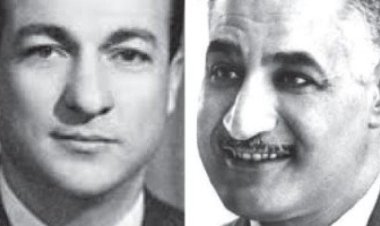
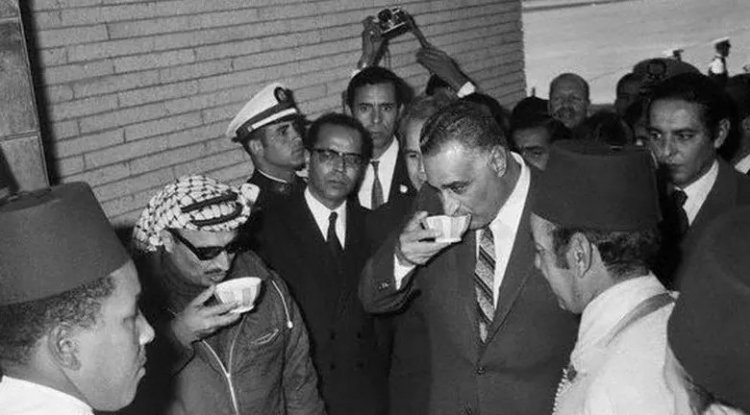
Nasser Introduces Yasser Arafat to King Hassan II for the First Time at the Rabat Summit
Written by Saeed Al-Shahat
Translated by Mahmoud Al-Shafei
Reviewed by Mohaned Mohammed
President Gamal Abdel Nasser was among the last heads of state to arrive in the Moroccan capital, Rabat, on December 20, 1969, to attend the Arab Summit which commenced that same evening, according to Al-Ahram newspaper's issue on December 21, 1969.
Before departing Cairo, Nasser met with the Saudi monarch, King Faisal, twice on Friday, December 19, and they performed the Friday prayer at Al-Azhar. Subsequently, Nasser met with Yasser Arafat, Chairman of the Palestine Liberation Organization (PLO), who had arrived in Cairo en route to Rabat. Prior to his departure, Nasser decided to appoint Anwar Sadat as his vice president; Al-Ahram confirmed that "Sadat took the oath before the President yesterday morning before the latter departed for Rabat."
Al-Ahram reports that the President received both a popular and official welcome in Rabat. He was accompanied on his flight by Yasser Arafat and Khalid al-Hassan, the political official of the PLO. Both Arafat and al-Hassan wore commando (Fedayeen) uniforms upon leaving the plane. King Hassan II received President Nasser with an embrace at the aircraft steps. Al-Ahram reveals that this was the first meeting between Arafat and the Moroccan monarch, stating, "Yasser Arafat followed the President, who introduced him to the King; Hassan II extended his arms to the Palestinian leader in their first-ever encounter." The report adds: "Arafat did not participate in the monarchs’ review of the guard or the national anthem salutes, but later accompanied them to the airport lounge, where the King introduced them to senior Moroccan officials."
In his article, "Hassan II: Read Machiavelli as a Prince and Applied His Views as a King" (Wajhat Nazar magazine, November 1999), journalist Mohamed Hassanein Heikal notes that the conference aimed to discuss a volatile stage of the conflict with Israel. The guns of the War of Attrition were thundering on the Suez front, while the "Rogers Plan" -proposed by the U.S. Secretary of State for a peaceful settlement- consisted of formulations being whispered in the summit corridors. General points of the project had reached some Arab capitals before the summit, though it was not yet a complete proposal. Bilateral discussions regarding its phrasing were underway, and it was clear that Egypt did not accept what it knew of the project, though it had not yet announced an official rejection, preferring to wait for the summit’s deliberations.
Heikal reveals that he met King Hassan II at the palace designated for the summit. The King pointed to papers on his desk and said: "I presume you have seen the important points of the Rogers Plan, which is now before us. I sensed from President Nasser that he does not want a general discussion about it in the conference, nor even informal consultations. He wishes to avoid a public debate that might restrict his ability to maneuver and move in any direction he chooses after gauging the Arab situation through the summit. He also does not wish to hear the cheap grandstanding we hear from some, and you know whom I mean."
Heikal adds: "The King then summarized: 'President Nasser does not want a discussion that suggests a tendency toward rejection, as this would take the matter out of his hands, nor one that suggests a tendency toward acceptance, as this would weaken his position. I understand all of this, but what comes next?'" Heikal recalls: "The King frowned as he said: 'A solution is necessary. Thinking of a military solution is an absolute impossibility; Israel is stronger than us, and the Americans are behind them unconditionally. You yourself attended some sessions and saw those who are happy with your entanglement in the 1967 war; I do not think you can rely on their assistance.'"
Heikal notes that the King paused again to choose his words carefully, then slowly elaborated, "You do not make good use of the assets you possess in a conflict that concerns all Muslims and Arabs. I do not wish to propose anything to you, but I want you to study. You have not studied Morocco; you know nothing of the Jews of Morocco; you have not sufficiently followed the centers of influence in Israel. Do you know there is a political party that is almost the largest there that trusts me? Moroccan Jews are a fundamental pillar in every political structure in Israel, and all Moroccan Jews consider me their legitimate king because their experience in Morocco differed from any other Arab country due to specific circumstances. Israeli politicians all take our movement within the heart of Israeli society into account, and, strangely, Arab politicians do not know this."
"The King felt he had delivered his message with the utmost intensity and impact. He then asked whether what he had mentioned might open a path for a political movement of a more daring and imaginative nature than anything that had occurred so far, and whether President Nasser was prepared to hear what he had to offer.", Heikal concludes.
English Language Coordinator: Mariam Essa