Abdel Nasser and The Recent Kemetists
Written by Amr Sabih

Translated by Menna Tarek
Reviewed by Mariam Essa
The new Kemetists, advocates of Egyptian nationalism, claim that President Gamal Abdel Nasser was hostile to ancient Egypt. They argue that he adopted Arab nationalism as an alternative to Egyptian nationalism.
If these Kemetists had read President Abdel Nasser's book The Philosophy of the Revolution, they would have found that he envisioned Egypt playing a leading role in the Arab, African and Islamic worlds. If they had studied Abdel Nasser's history, they would also have known that all of his struggles were, first and foremost, for Egypt.
Regarding Gamal Abdel Nasser's view of ancient Egyptian civilization, one can notice the following points:
-
In March 1955, Gamal Abdel Nasser ordered the statue of King Ramses II to be moved from Mit Rahina to Bab El Hadid Square. The statue was erected there, and the square was later renamed Ramses Square.
-
Gamal Abdel Nasser also decided to rename Queen Nazli Street as Ramses Street.
-
In the same year, the American director Cecil B. DeMille came to Cairo to obtain the necessary permits to film The Ten Commandments, which tells the story of the Children of Israel in Egypt, Pharaoh's persecution of them, the prophethood of Moses, their exodus from Egypt to Sinai and the wilderness, and the Prophet Moses' receiving of the Ten Commandments. During DeMille's visit to Cairo, he met President Gamal Abdel Nasser and informed him that he intended to film the movie in Egypt. He asked the President for the Egyptian government's cooperation. DeMille also filmed and directed a speech by President Abdel Nasser, which was broadcast around the world. The Egyptian government provided Cecil B. DeMille with all the facilities required to produce the film. Hossam El-Din Mostafa worked with him as an assistant director. The film was shot in 1956. While watching the film, President Gamal Abdel Nasser was surprised by the scene depicting the Egyptian army, led by King Ramses II, drowning in the sea while pursuing the fleeing Jewish slaves. He was angered by this scene and ordered that the film be banned in Egypt. He also decided that no foreign film would be permitted to be shot in Egypt unless it had first been reviewed by the Egyptian censorship authorities. When DeMille protested, arguing that he had portrayed the story of the Prophet Moses as it appears in the holy books, the Egyptian response was that the Holy Qur'an does not identify King Ramses II as the Pharaoh who persecuted the Jews. It mentions only "Pharaoh" by title, and there is no conclusive historical or archaeological evidence establishing that Jews were present in Egypt during the reign of King Ramses II.
-
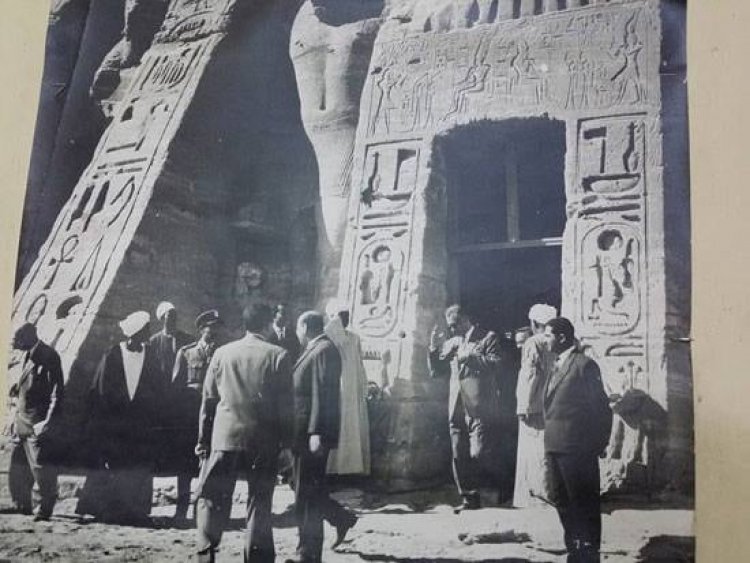
Gamal Abdel Nasser commissioned Tharwat Okasha, Egypt's most prominent Minister of Culture, to save the Nubian monuments, including the temples of Abu Simbel and Philae. This became a global undertaking that marked the largest operation to protect world heritage under UNESCO's auspices during the twentieth century.
-
Gamal Abdel Nasser restored justice to the great archaeologist Dr. Selim Hassan, the author of the Encyclopedia of Ancient Egypt, who had been persecuted by King Farouk I and forced into retirement in 1939. Dr. Selim Hassan was the first Egyptian to serve as an inspector in the Egyptian Antiquities Authority in 1936. While reviewing an inventory of the Authority's antiquities, he discovered that King Fouad had removed an archaeological collection and kept it in his palace. He contacted the royal palace to recover the collection; eventually, it was returned to the authority and placed on display at the Egyptian Museum in Cairo. After the death of King Fouad and the accession of King Farouk, the new king demanded that the Antiquities Authority return the collection to him, claiming it as part of his inheritance from his father. Dr. Selim Hassan replied that the antiquities belonged to Egypt and refused to return them to the royal palace. His decision angered King Farouk, who continued trying to remove him from office until he succeeded by issuing a decree forcing Dr. Selim Hassan into retirement in 1939. After his retirement, his academic work was restricted. Following his retirement, Dr. Selim Hassan devoted himself to completing his sixteen-volume encyclopedia on the history of ancient Egypt, which is regarded as the most important encyclopedia on ancient Egyptian history. He also completed his important work on ancient Egyptian literature. After the July 23 Revolution of 1952, President Gamal Abdel Nasser recognized the importance of this distinguished scholar and the honor he had brought to Egypt and its people. He issued a decision sending Dr. Selim Hassan to visit museums around the world that house Egyptian antiquities. In 1959, he also appointed him as an adviser to the Egyptian Museum in Cairo. In 1960, Dr. Selim Hassan was honored by the New York Academy of Sciences, an institution that included more than 1,500 scholars from 57 countries, and he was unanimously elected as a member.
-
During President Gamal Abdel Nasser's era, Egypt's first Faculty of Archaeology was established at Cairo University by a decision of the University Council for Postgraduate Studies and Republican Decree No. 1803 of 1970.
-
The distinguished geographer Dr. Jamal Hamdan wrote in his personal papers, published in The Scholar Dr. Jamal Hamdan and Glimpses from His Private Memoirs:
"Gamal Abdel Nasser was the first Egyptian ruler and leader to discover the essence of Egypt's political personality and to formulate the ideal framework for Egyptian foreign policy. Abdel Nasser did not invent this ideal framework for Egypt's foreign policy, but he was the first to absorb it, understand it, formulate it intellectually, and apply it in practice to the greatest possible extent, transforming it from political thought into political action. Unfortunately, just as he was the first to understand and apply Egypt's political geography as it should be, he has also remained the last to do so. In The Philosophy of the Revolution, Abdel Nasser formulated an authentic geopolitical vision for Egypt by defining the circles of Egyptian foreign policy. The Arab circle is surrounded by the African circle, and together they are encompassed by the Islamic circle, reflecting remarkable foresight, with influence extending from the nearest circle to the farthest. Gamal Abdel Nasser was the architect of Egypt's future manuscript, and his experience was only the beginning of the Egypt we aspire to build, Great Egypt. Nasserism is Egypt's intellectual foundation, shaped by the combined forces of its history and geography. Nasserism is Egypt's path toward the future. It cannot come to an end or be replaced because it represents Egypt's inevitable political course and remains a duty for every patriotic Egyptian ruler who comes after Abdel Nasser. Nasserism represents Egypt as it should be. If you are Egyptian, then you are a Nasserist, whether you like it or not and whether others oppose it or not, unless you are not Egyptian or stand against Egypt. We are all Nasserists, whether we acknowledge it or not. We are all, in one way or another, Gamal Abdel Nasser, even if we disagree with him or reject him as a person or reject his achievements. No ruler who comes after Abdel Nasser can depart from Nasserism unless he abandons his Egyptian identity. Every Egyptian may reject Gamal Abdel Nasser, but no Egyptian can reject Nasserism. Otherwise, he would be rejecting his own Egyptian identity. There is no escape from Nasserism for an Egyptian, for it is Egypt's destiny, its destination and the compass that guides its future. Nasserism is neither a vague mystery nor a complicated philosophy. It is simply Egypt, strong, proud, prosperous, and independent both internally and externally. Nasserism is the vision of every patriotic Egyptian who aspires for Egypt to reclaim its place as a major international power. The Egyptian nationalist was a Nasserist before Abdel Nasser and remains a Nasserist after him."
Gamal Abdel Nasser was not hostile to ancient Egypt or to Egyptian nationalism, as Kemetists and those who followed the same approach have claimed. Rather, he understood Egypt's value and the importance of its leading regional role in accordance with the realities and requirements of his time, rather than the aspirations of those who sought to revive a great civilization that had long since passed into history.
The photograph shows President Gamal Abdel Nasser during his visit to Abu Simbel Temple in 1961, before the dismantling and relocation of the temple began to protect it from submersion following the construction of the High Dam.
______________________________________________________
English Language Coordinator: Mariam Essa